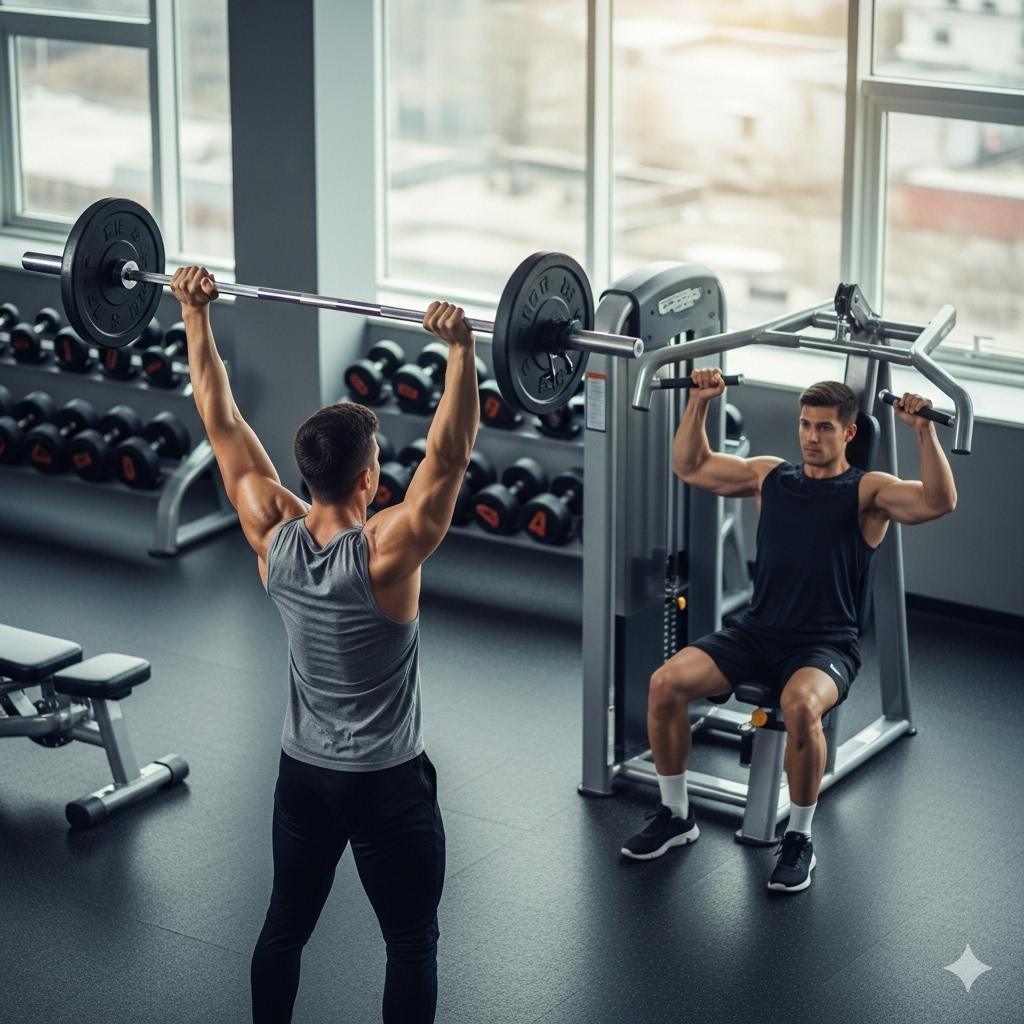

When it comes to building upper body strength, few exercises spark as much debate as the overhead press and the shoulder press machine. Many lifters wonder if the shoulder version done on a machine is truly better than the free-weight overhead press, often shortened to OHP. The truth is, both options have their place depending on your goals. The free-weight OHP challenges stabilizing muscles, balance, and overall coordination, making it a powerhouse movement for functional strength.
In contrast, the shoulder press machine removes the stability requirement, allowing you to focus purely on pressing power and muscle hypertrophy. Some athletes argue that the machine is better for beginners or those recovering from injury, while advanced lifters often lean toward the raw strength benefits of the free-weight overhead press.
Interestingly, in competitive lifting history, the OHP was once a contested lift but later became banned in official Olympic weightlifting because of inconsistent judging and form standards. Despite being banned on the platform, the exercise remains a cornerstone in strength training. Ultimately, the smartest approach is not to label one as universally better, but to combine both, using the machine for volume and the overhead press for strength
What Is the Overhead Press?
The overhead press (sometimes called the military press) is a free-weight exercise where you push a barbell (or dumbbells) from chest level straight up over your head.
It’s considered a compound movement, meaning it works multiple muscle groups at once. Here’s what’s firing up when you perform it:
-
Deltoids (shoulders) – main movers
-
Triceps – helping extend your elbows
-
Traps and upper back – stabilizing
-
Core and abs – keeping you upright
-
Even your glutes and legs – if you’re standing
In short, the overhead press isn’t just about shoulders. It’s a full-body movement that demands balance, coordination, and strength.
How to Perform It (Barbell Version)
-
Stand tall with your feet shoulder-width apart.
-
Hold the barbell at chest height with palms facing forward.
-
Keep your core tight (like someone’s about to poke your stomach).
-
Press the barbell straight overhead until your arms are locked out.
-
Lower it back down with control.
Sounds simple? Yes. Easy to master? Not quite — and that’s what makes it such a powerful lift.
What Is the Shoulder Press Machine?
The shoulder press machine looks friendlier and less intimidating than a barbell. You sit down, grab the handles, and push upward against resistance provided by the machine’s weight stack.
Here’s why many people (especially beginners) like it:
-
The machine keeps the movement guided and stable.
-
There’s less need to worry about balance or bar path.
-
You can quickly adjust the weight to suit your level.
-
Great for isolating the shoulders without stressing your lower back.
The main muscles worked are still the shoulders and triceps, but because the machine does the balancing for you, fewer stabilizing muscles get involved compared to the overhead press.
Key Differences Between Exercises
At first glance, they look similar. But once you dig deeper, you’ll see they serve different purposes. Let’s compare them side by side.
1. Equipment Used
-
Overhead Press: Barbell or dumbbells, performed free-weight style.
-
Shoulder Press Machine: Fixed path with handles and a weight stack.
2. Muscles Activated
-
Overhead Press: Shoulders + triceps + core + stabilizers (big compound movement).
-
Machine Press: Primarily shoulders and triceps (less stabilizer involvement).
3. Difficulty Level
-
Overhead Press: Harder — requires balance, form, and coordination.
-
Machine Press: Easier — guided path, beginner-friendly.
4. Range of Motion
-
Overhead Press: Limited by bar path, but engages more muscles overall.
-
Machine Press: Usually allows for adjustable grips and slightly varied range.
5. Progression
-
Overhead Press: Great for building long-term raw strength.
-
Machine Press: Safer for higher reps and hypertrophy (muscle growth).
Benefits of the Overhead Press
Why do so many strength coaches love the overhead press? Because it offers a ton of bang for your buck.
-
Builds total-body strength (not just shoulders).
-
Improves posture by strengthening upper back and core.
-
Carries over to real-life activities (lifting boxes overhead, sports, etc.).
-
Boosts pressing strength for other lifts (bench press, push press).
But let’s be honest — it’s not easy. If your form is off, you risk shoulder or lower back strain. That’s why it’s often better for intermediate to advanced lifters who have good mobility and stability.
Benefits of the Shoulder Press Machine
The shoulder press machine doesn’t get the same “hardcore” reputation, but it has its place — especially if you’re chasing muscle size or working around injuries.
-
Provides safety and stability — no bar to drop.
-
Easy to adjust weight — perfect for drop sets or quick changes.
-
Lets you focus purely on your shoulders without worrying about balance.
-
Good option if you’re rehabbing or have limited mobility.
Think of it as a more controlled, targeted way to hit your shoulders.
Which One Builds More Strength?
The Case for the Overhead Press
The overhead press (OHP) is widely considered one of the best exercises for building raw, full-body strength. Because it is a free-weight movement, you are not only pressing the bar overhead but also stabilizing your entire body. Your core, back, and even legs are engaged to keep you upright, making it a true compound lift. This demand on multiple muscle groups trains your nervous system to coordinate force efficiently, which directly translates to greater overall strength. For athletes and those chasing functional performance, the overhead press is unmatched.
The Case for the Shoulder Press Machine
The shoulder press machine, while effective for building muscle, does not deliver the same level of total-body strength. Since the machine stabilizes the weight for you, the demand on your core and supporting muscles is minimal. However, this does not mean it has no strength benefits. The machine allows you to overload the shoulders safely and push heavier in isolation, which can indirectly contribute to pressing strength over time. It is especially useful for hypertrophy phases, where the goal is adding muscle mass to later convert into strength.
Pros and Cons of the Overhead Press vs Shoulder Press Machine
Every exercise has strengths and weaknesses. Both the overhead press and the shoulder press machine have unique advantages, but also some limitations. Here’s a detailed breakdown:
Pros of the Overhead Press
-
Full-Body Engagement
Beyond the shoulders, this lift recruits the core, back, and lower body to stabilize the movement. -
Strength Builder
It develops raw pressing power and is considered a foundational strength exercise. -
Improves Posture
By targeting upper back and trap muscles, it naturally helps correct rounded shoulders from sitting too much. -
Functional Carryover
The movement translates into everyday tasks and sports, making it highly practical.
Cons of the Overhead Press
-
High Learning Curve
Proper technique requires practice, and beginners often struggle with balance and bar path. -
Shoulder Stress
Poor mobility or pre-existing injuries can make the overhead press uncomfortable. -
Risk of Injury with Poor Form
Pressing too heavy without good mechanics can strain the shoulders and lower back. -
Plateaus Easily
Progress tends to stall faster compared to other lifts, which can be frustrating.
Pros of the Shoulder Press Machine
-
Beginner-Friendly
The guided motion makes it easy to learn and use. -
Hypertrophy Potential
Without stabilizers fatiguing, the shoulders can be trained with higher volume for muscle growth. -
Safer for Solo Training
No spotter is needed, and failure is low risk. -
Customizable Grips and Angles
Many machines allow adjustments for comfort and reduced joint strain. -
Joint-Friendly
A more controlled movement makes it suitable for those with limited mobility or recovering from injury.
Cons of the Shoulder Press Machine
-
Less Functional Strength
It does not mimic natural movement patterns as effectively as free weights. -
Neglects Stabilizers
Core and smaller support muscles are not significantly engaged. -
Fixed Path Limitations
Machines may not align perfectly with every body type, leading to awkward mechanics. -
Potential for Overuse
Because it feels controlled, lifters often overload the machine, which can still cause stress on joints.
Final Takeaway
The overhead press and the shoulder press machine are not rivals — they’re tools with different strengths. The overhead press builds raw power, coordination, and functional strength that carries over to sports and daily life. The shoulder press machine, on the other hand, provides a safe and effective way to isolate the shoulders, push for higher reps, and grow muscle size.
Instead of asking which one is “better,” think of them as complementary. Use the overhead press as your foundation for strength, then add the machine to increase volume and hypertrophy. By combining both intelligently, you’ll not only press more weight but also build shoulders that are strong, stable, and well-rounded.