
Introduction
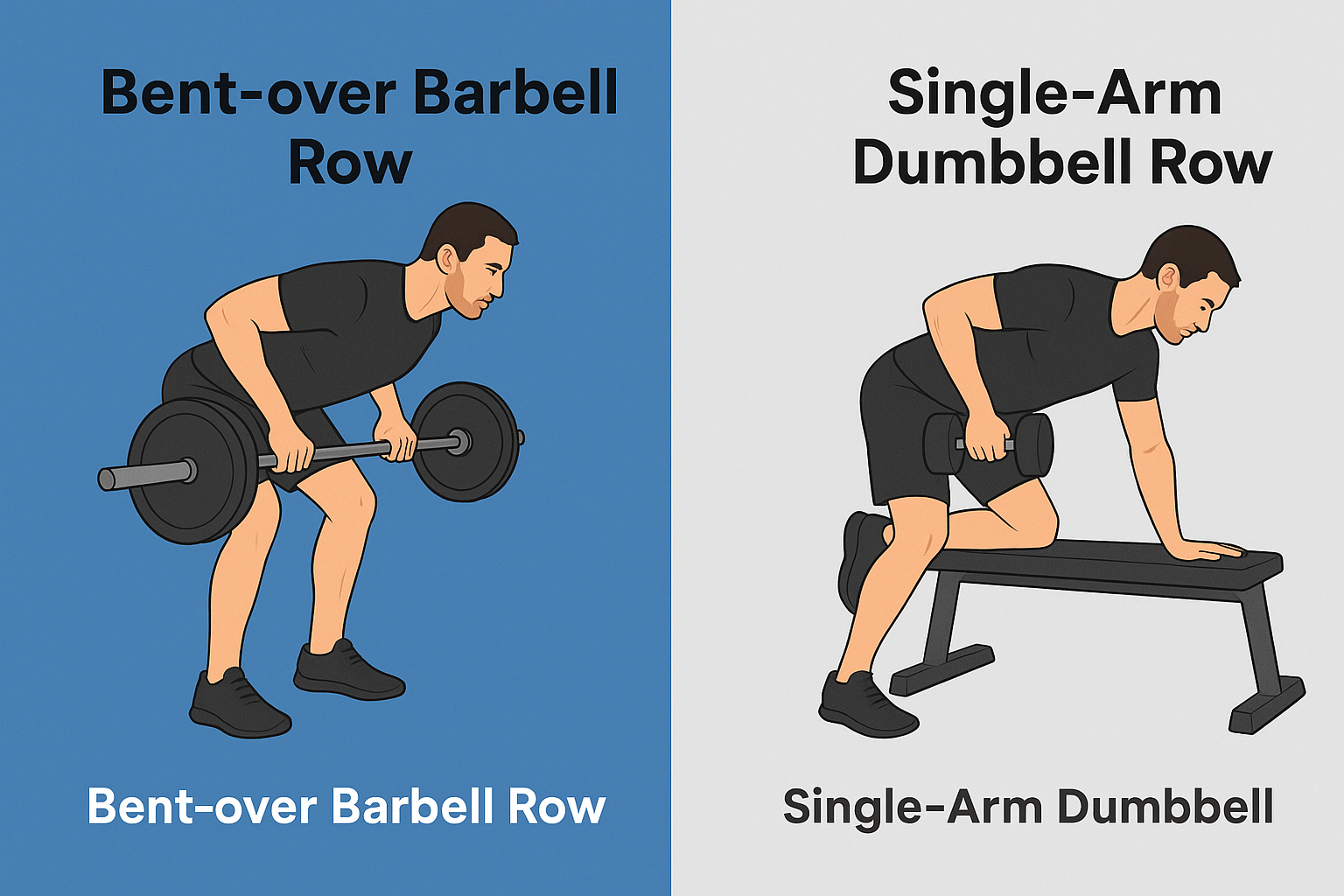
When it comes to building a strong, wide, and balanced back, two exercises dominate the conversation: the bent-over barbell row and the dumbbell row. On the surface, both seem similar — hinge at the hips and pull weight toward your torso. But here’s the twist: the choice between them can change how your muscles grow, how your strength develops, and even how safe your lower back feels.
So, should you grab a barbell or stick with dumbbells? Let’s break down the differences, benefits, and which one suits your goals best.
Bent-over Barbell Row: Strength and Power
The bent-over row is a bilateral movement, meaning both arms work together. This setup has some big advantages:
-
Maximum load capacity: Since both arms share the bar, you can lift much heavier weights compared to dumbbells.
-
Full-body engagement: Your lower back, glutes, and hamstrings stabilize the lift, making it almost a compound movement.
-
Progressive overload friendly: It’s easier to add small weight increments on a barbell, which supports long-term strength progression.
-
Grip versatility: Overhand grip targets the traps and rhomboids, while underhand grip shifts focus to the lats.
👉 Best for: Lifters chasing raw strength and mass in the upper and middle back.
Dumbbell Row: Balance and Range of Motion
The one-arm dumbbell row focuses on unilateral training — working one side at a time. This brings unique benefits:
-
Corrects imbalances: Each side lifts independently, preventing one arm from overpowering the other.
-
Greater range of motion: Dumbbells move freely, allowing a deeper stretch at the bottom and stronger contraction at the top.
-
Lower back relief: Bracing one hand on a bench removes stress from your spine, ideal if your back is already taxed by deadlifts or squats.
-
Core stability challenge: Because it’s a one-sided exercise, your abs and obliques fight to keep your torso stable.
👉 Best for: Lifters focusing on muscle growth, symmetry, and joint-friendly training.
Bent-over Barbell Row vs Single-Arm Dumbbell Row
| Feature | Bent-over Barbell Row | Single-Arm Dumbbell Row |
|---|---|---|
| Movement Type | Bilateral – both arms pull together | Unilateral – one arm works at a time |
| Weight Capability | Allows much heavier overall loading | Moderate load but heavier per side |
| Back Stability | Demands strong lower back & core | Bench support reduces lower back strain |
| Imbalance Fixing | Less effective for corrections | Excellent for evening out imbalances |
| Range of Motion | Limited by bar path | Greater stretch + deeper contraction |
| Best For | Building raw strength & mass | Hypertrophy, symmetry & back-friendly |
Tips from YouTube (Practical Advice)
After analyzing multiple fitness videos (like those in your shared link), here are actionable tips for each exercise:
For Barbell Rows
-
Keep your torso at a 45° angle — too upright turns it into a shrug, too low stresses your lower back.
-
Avoid using momentum. If you’re jerking the bar, it’s too heavy.
-
Use a mixed grip or lifting straps if your grip strength limits your pull.
For Dumbbell Rows
-
Don’t just pull the dumbbell straight up — think about pulling toward your hip for maximum lat activation.
-
Let your arm hang at the bottom for a full stretch before rowing up.
-
Keep your head neutral and your core tight to avoid twisting your torso.
Latest Fitness Posts — Muscle & Workout
Bent-over Row vs Dumbbell Row: Which Builds a Better Back?
What Are Probiotics? Complete Guide for Male and Female
Pull-Ups vs Chin-Ups: A Complete Guide for Parents
Crunch vs Goblet Squats: A Complete Comparison
How Goblet Squats Improve Core, Strength, and Posture
Dumbbell Chopper: Full-Body Core Power in Motion
The Complete Guide to Push-ups: Benefits, Form, and Daily Routine
Dumbbell Bench Press: Unlocking Upper Body Strength and Stability
Bicep Curl: Mastering the Art of Arm Strength
Are Lunges the Most Effective Exercise for Strength and Balance?
Final Words
Both the bent-over barbell row and the single-arm dumbbell row have their place in a smart training program. The barbell row builds raw pulling strength and overall back mass, while the dumbbell row allows for greater control, symmetry, and range of motion. Instead of treating them as rivals, think of them as teammates. Use the barbell row to lay down thick slabs of strength, and add dumbbell rows to fine-tune balance and muscle detail. When you combine both, you create a complete back workout that’s strong, stable, and well-rounded — the kind of back that not only looks impressive but also performs powerfully in and out of the gym.