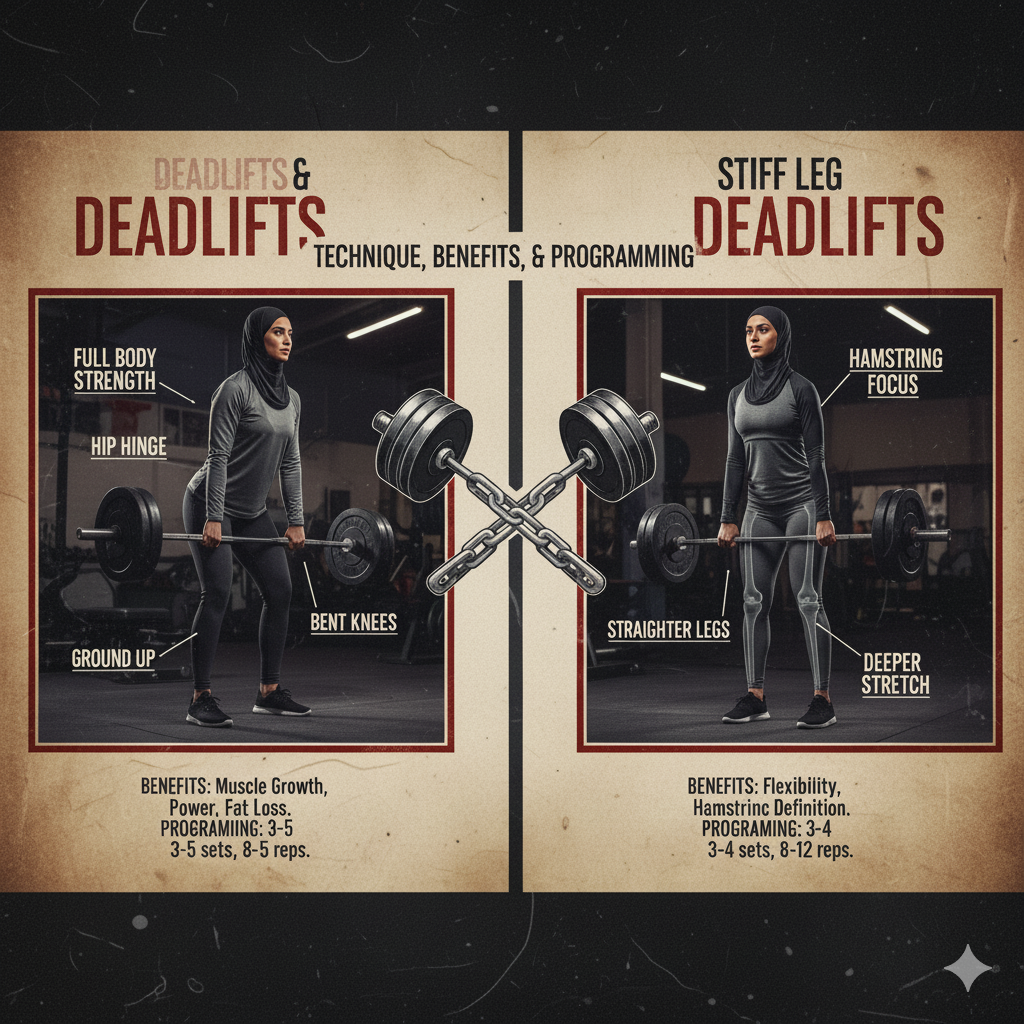

When it comes to building strength and muscle, lifters often debate RDL vs SLDL because both target the hamstrings and glutes but in slightly different ways. The Romanian Deadlift (RDL) uses a controlled hip hinge with a soft knee bend, making it easier for beginners to master, while the Stiff Leg Deadlift (SLDL) keeps the legs straighter and increases the stretch on the hamstrings. This leads many to question stiff-leg deadlifts effectiveness, and the truth is they are extremely effective when performed with proper form.
They not only build hamstrings and glutes but also strengthen the lower back and improve overall posterior chain development. However, some lifters still wonder what the best deadlift form is. The answer depends on your goals: conventional deadlifts are great for total strength, RDLs are perfect for controlled hamstring growth, and stiff leg deadlifts are excellent for maximizing stretch and tension. Another common debate is stiff leg deadlift vs leg press, where the leg press isolates the quads more, while stiff leg deadlifts emphasize hamstrings and glutes. Both have value, but combining them in a smart program ensures balanced strength, improved performance, and better aesthetics for anyone serious about training.
What Exactly Is a Deadlift?
A deadlift is a strength training exercise where you lift a barbell (or other weight) from the ground up to hip level. Sounds simple, right? But don’t let the simplicity fool you—it’s one of the most powerful movements you can do because it recruits nearly every muscle in your body.
When you deadlift, you’re training:
-
Legs: quads, hamstrings, glutes
-
Back: traps, lats, erector spinae
-
Core: abs and obliques
-
Grip: forearms and hands
Basically, if you want a full-body strength booster, the deadlift is your best friend.
Why Is It Called a Deadlift?
It’s called a dead lift because you’re lifting a “dead” weight (completely still and not moving) from the ground. Unlike squats or bench press, where the bar starts elevated, the deadlift begins with no momentum—just you, gravity, and the bar.
The Benefits of Deadlifts
If you’re wondering, “Why should I even bother with deadlifts?”—here are some reasons:
-
Strength Gains Everywhere – Few exercises build overall strength like the deadlift.
-
Functional Movement – You lift things off the ground in real life; this makes you better at it.
-
Better Posture – Strengthening your back and core helps you stand taller.
-
Hormonal Boost – Heavy compound lifts trigger testosterone and growth hormone release.
-
Athletic Performance – Stronger glutes and hamstrings mean faster sprints and more explosive jumps.
In short, deadlifts don’t just make you stronger—they make you better at life.
Types of Deadlifts
Before we zoom in on stiff leg deadlifts, let’s quickly look at the common variations:
-
Conventional Deadlift – The classic stance, feet hip-width apart, hands just outside knees.
-
Sumo Deadlift – Wide stance, toes pointed out, hands inside the legs. Great for hip mobility.
-
Romanian Deadlift (RDL) – Similar to stiff leg, but with a slight knee bend and controlled hip hinge.
-
Trap Bar Deadlift – Uses a hexagonal bar; easier on the lower back.
Each has its place, but today we’re focusing on conventional deadlifts and their close cousin, the stiff leg deadlift.
What Is a Stiff Leg Deadlift?
The stiff leg deadlift (SLDL) is often confused with the Romanian deadlift, but it has its own unique twist. In the stiff leg version, your knees stay almost straight (but not locked out) as you hinge at the hips to lower the bar.
This makes it a hamstring and lower back-dominant exercise, while the regular deadlift recruits more quads and overall muscle groups.
Comparison Between 2 exercises
| Feature | Deadlift | Stiff Leg Deadlift |
|---|---|---|
| Knee Bend | Moderate | Minimal |
| Primary Muscles Worked | Glutes, quads, hamstrings, back, core | Hamstrings, glutes, lower back |
| Range of Motion | Bar stops at floor | Bar may go slightly below knees (depending on flexibility) |
| Strength Focus | Overall strength & power | Hamstring stretch and posterior chain strength |
| Best For | Total-body strength, athletes, general fitness | Muscle isolation, hamstring growth, lower back strength |
Think of it this way: deadlifts are the all-around powerhouse, while stiff leg deadlifts are the laser-focused hamstring builders.
Step-by-Step Guidance
Here’s a breakdown you can follow in the gym:
-
Set Up
-
Stand with feet hip-width apart.
-
Barbell should be over mid-foot.
-
Grip the bar just outside your knees.
-
-
Get Tight
-
Keep your chest up and back flat.
-
Engage your core like you’re about to get punched in the stomach.
-
-
Lift Off
-
Push through your heels.
-
Extend hips and knees at the same time.
-
Keep the bar close to your body.
-
-
Lockout
-
Stand tall, chest proud.
-
Squeeze glutes at the top.
-
-
Lower Safely
-
Reverse the movement with control.
-
Don’t just drop the bar unless it’s a powerlifting setting.
-
How to Perform a Stiff Leg Deadlift
-
Start Position
-
Hold a barbell at hip height with an overhand grip.
-
Feet shoulder-width apart.
-
-
The Hinge
-
Keep knees slightly bent, not locked.
-
Hinge at the hips and lower the bar toward your feet.
-
Keep your back straight, not rounded.
-
-
Depth
-
Lower until you feel a deep stretch in your hamstrings.
-
Don’t force the bar to the floor if your flexibility doesn’t allow it.
-
-
Return
-
Squeeze hamstrings and glutes to return to standing.
-
Avoid using your lower back only—think of your hips driving forward.
-
Popular Mistakes
Both deadlifts and stiff leg deadlifts are simple but easy to mess up. Watch out for these errors:
-
Rounding Your Back – Leads to injury. Keep chest up and spine neutral.
-
Locking Knees in SLDL – Knees should be soft, not locked.
-
Letting the Bar Drift Away – Keep it close to shins and thighs.
-
Lifting With Lower Back Only – Engage hips and glutes.
-
Overloading Too Soon – Form first, weight later. Always.
Deadlift & Stiff Leg Deadlift for Muscle Growth
If your goal is aesthetics (muscle building), here’s how to use these lifts:
-
Deadlifts → Best for overall thickness, traps, and spinal erectors.
-
Stiff Leg Deadlifts → Best for hamstring size and definition.
A great program includes both, but with smart programming. For example:
-
Heavy deadlifts once a week.
-
Stiff leg deadlifts (lighter, higher reps) once or twice a week.
Safety First: Protecting Your Back
Let’s be real: deadlifts are safe if done correctly, but dangerous if done sloppy. Some tips:
-
Warm up with dynamic stretches (hip hinges, bodyweight good mornings).
-
Never sacrifice form for weight.
-
Strengthen your core separately (planks, ab rollouts).
-
Use lifting straps or mixed grip if grip becomes a limiting factor.
Remember, your ego may want to lift heavy, but your spine disagrees.
Should Beginners Do Stiff Leg Deadlifts?
Yes—but carefully. Beginners should master the hip hinge pattern first (bodyweight good mornings, kettlebell deadlifts) before attempting stiff leg deadlifts with a barbell. Once your flexibility and control improve, you can safely add them.
Working Deadlifts and Stiff Leg Deadlifts into the Same Plan
Here’s a sample weekly split:
-
Day 1 (Strength): Heavy conventional deadlifts, 4–6 sets of 3–5 reps.
-
Day 3 (Accessory/Hypertrophy): Stiff leg deadlifts, 3–4 sets of 8–12 reps.
This balance gives you the best of both worlds—raw strength and muscle isolation.
Deadlift & Stiff Leg Deadlift FAQs
Q: Which is harder?
A: Deadlifts usually feel heavier because of the load, but stiff leg deadlifts can feel more painful because of the hamstring stretch.
Q: Can I do both on the same day?
A: Yes, but don’t max out both. Use one as the main lift and the other as an accessory.
Q: Do I need a belt?
A: A belt can help on heavy lifts, but it’s not mandatory for lighter accessory work.
Q: Will they make me bulky?
A: No—deadlifts build lean muscle and strength. You control the “bulk” with diet.
Conclusion
The deadlift is your powerhouse movement—great for building full-body strength, athleticism, and resilience. The stiff leg deadlift, on the other hand, is the sculptor—shaping your hamstrings, glutes, and posterior chain with precision.
If you want to be strong and look strong, you need both. The key is learning proper form, respecting the movement, and progressing at your own pace.
So, next time you hit the gym, don’t just pick up the bar—pick up the knowledge too. Your body will thank you later.