
Introduction
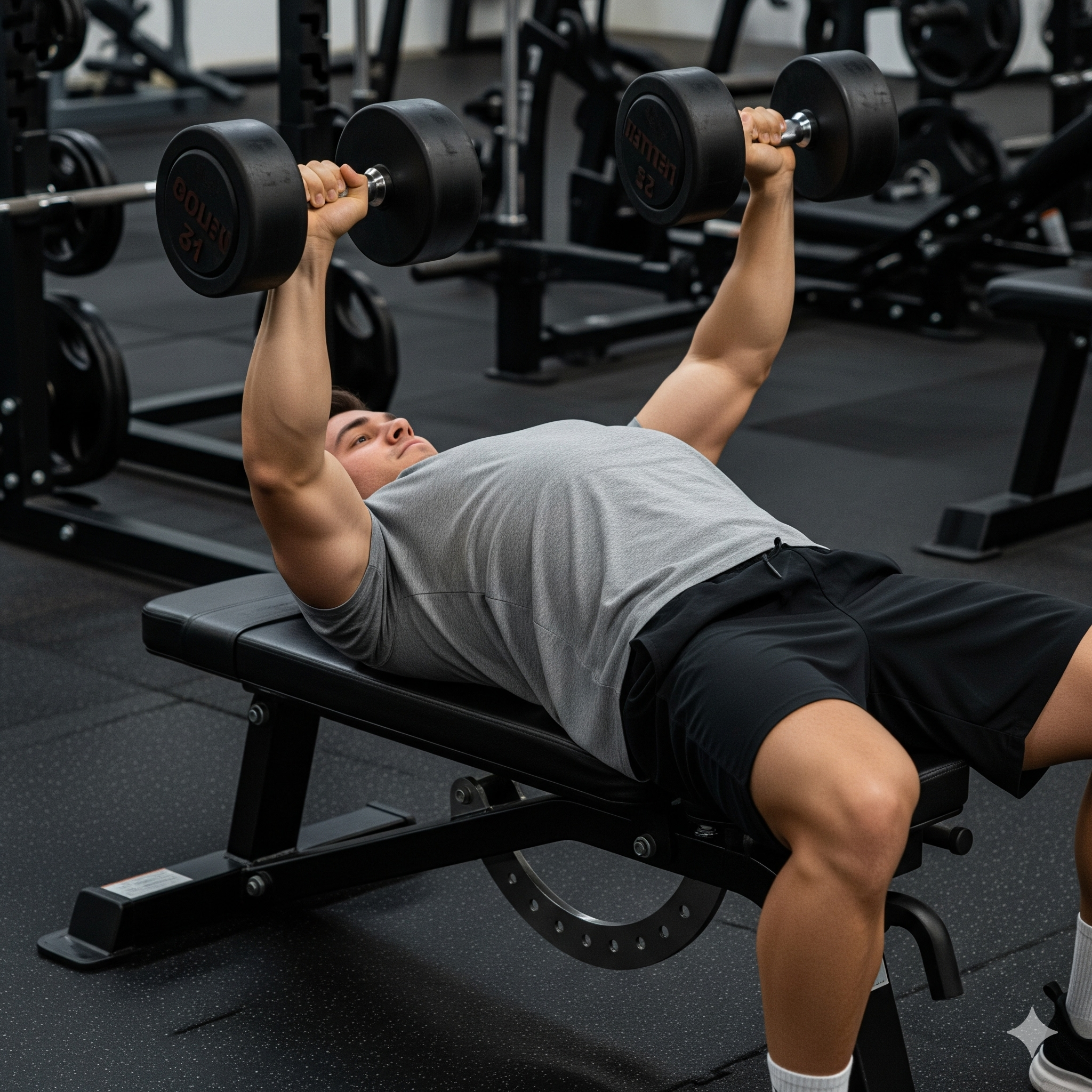
The dumbbell bench press is a cornerstone exercise for building upper body strength, targeting the chest, shoulders, and triceps while engaging stabilizer muscles for improved balance and control. Unlike the barbell bench press, dumbbells allow each arm to move independently, increasing range of motion, correcting muscle imbalances, and promoting safer, more natural lifting mechanics. Whether you’re a beginner aiming to develop proper form or an experienced lifter seeking hypertrophy and functional strength, the dumbbell bench press offers versatility, effectiveness, and long-term benefits for overall fitness.
Improved Range of Motion
Dumbbells allow for a deeper stretch at the bottom and a fuller contraction at the top, targeting the chest more effectively than a fixed barbell path.
Better Muscle Activation
Independent movement recruits stabilizer muscles, including shoulders and core, enhancing overall upper body strength.
Reduced Muscle Imbalances
Forces each arm to work independently, identifying and correcting asymmetries between left and right sides of the body.
Versatility in Grip
Adjusting hand position—neutral, pronated, or angled—targets different chest areas and reduces shoulder stress, ideal for mobility restrictions or minor injuries.
Functional Strength Development
Strengthens muscles to improve everyday movements, such as lifting, pushing, or supporting weight in uneven positions.
Improved Muscle Growth and Strength
One of the main reasons athletes and fitness enthusiasts favor the dumbbell bench press is its effectiveness for hypertrophy and strength development.
Hypertrophy
Dumbbells enable a natural movement pattern, stretching the chest at the bottom and engaging the anterior deltoids and triceps throughout the lift. This range of motion increases muscle fiber recruitment, which contributes to faster and more balanced muscle growth. For those looking to sculpt the chest while also strengthening the shoulders and triceps, dumbbells provide a superior option to the barbell in terms of muscle activation.
Full Range of Motion
The freedom of movement allows the elbows to drop slightly lower than a barbell press, creating a fuller contraction and stretch. This extra motion is critical for stimulating the chest fibers effectively, resulting in better hypertrophy outcomes over time.
Enhancing Stability and Muscle Balance
Improving stability and muscle balance involves exercises that strengthen the core, legs, and back while promoting proper posture and body awareness. By training these key areas, the body becomes more coordinated and responsive, enhancing overall movement efficiency and reducing the risk of injury. Core exercises such as planks, leg lifts, and rotational movements, combined with lower-body work like squats, lunges, and single-leg stands, develop strength and stability that carry over into daily activities and athletic performance.
How Stability and Balance Improve
-
Muscle Strength: A strong core, back, and lower body act as a foundation, supporting controlled and stable movement in all directions.
-
Neuromuscular Coordination: Targeted exercises enhance communication between the brain and muscles, allowing for faster, more precise reactions to shifts in balance.
-
Proprioception: Practicing single-leg exercises or balance work with eyes closed sharpens the body’s awareness of its position in space, which is essential for maintaining control.
-
Posture Enhancement: Strengthening postural muscles helps maintain proper alignment, reducing strain on the spine and joints during daily activities.
Effective Exercises for Stability and Balance
-
Core Training: Planks, bridges, and rotational exercises help the core work as a unified stabilizing unit.
-
Leg and Lower Body Strength: Squats, lunges, and single-leg stands strengthen the muscles that support the hips, knees, and ankles.
-
Balance Challenges: Incorporate single-leg holds, gradually increasing difficulty, or close your eyes to further enhance proprioception.
-
Unstable Surfaces: Advanced exercises on a balance board, Bosu ball, or stability ball provide additional challenge and improve neuromuscular control.
-
Mind-Body Practices: Yoga and Pilates combine strength, flexibility, and controlled movement to enhance balance, stability, and overall body awareness.
By consistently integrating these exercises into your routine, you can develop a body that is not only stronger but also more resilient, coordinated, and capable of handling both daily demands and athletic challenges.
Versatility and Accessibility
One of the greatest advantages of the dumbbell bench press is its adaptability for different fitness levels and goals.
Adjustable Grip
By changing hand angles—palms facing inwards (neutral), outwards, or even angled—users can target various parts of the chest, shoulder, and tricep muscles while also reducing discomfort in the shoulders.
Safer for Beginners and Those with Injuries
The dumbbell press allows for a safer exercise environment, as weights can be dropped or adjusted mid-lift without requiring a spotter. This makes it ideal for beginners or individuals with pre-existing shoulder or joint concerns who may find barbell presses restrictive.
Workout Variety
Dumbbells can be incorporated into multiple variations, such as incline or decline presses, neutral grip presses, or single-arm presses, allowing for diverse workouts that continuously challenge the muscles. This versatility supports long-term progress and prevents workout monotony.
Proper Form and Technique
Correct form ensures safety, maximizes results, and reduces injury risk.
Why Proper Form is Crucial
-
Injury Prevention: Maintaining alignment and control prevents strain on the shoulders, elbows, and wrists.
-
Optimal Muscle Engagement: Proper form targets the intended muscle groups more effectively.
-
Efficiency: Controlled movements maximize strength gains and hypertrophy.
-
Improved Performance: Good technique builds a foundation for heavier lifts and more complex exercises.
-
Reduced Muscle Imbalances: Working evenly ensures both sides develop equally.
Key Principles
-
Posture: Keep the spine aligned, shoulders retracted, and pelvis neutral.
-
Body Alignment: Joints, including wrists, elbows, and shoulders, should move in a natural, controlled pattern.
-
Core Engagement: Engage the abs to stabilize the torso and reduce lower back strain.
-
Controlled Movement: Avoid rapid, jerky motions; focus on smooth lifting and lowering phases.
-
Breathing: Inhale while lowering the weights and exhale during the pressing phase.
-
Full Range of Motion: Use the complete natural range, but avoid overstretching.
-
Start Light: Master form before adding heavy weights.
Seek Guidance
Coaches or qualified trainers can provide personalized feedback to ensure correct form and prevent injuries.
Watch and Mimic
Observe proper technique in gyms or through credible instructional videos to learn the correct movements.
Record Yourself
Filming lifts helps identify errors and track progress over time, ensuring continuous improvement.
Common Mistakes to Avoid
In both exercise and life, common mistakes can reduce progress or cause harm.
General Mistakes
-
Procrastination: Delaying workouts or decisions limits results.
-
Rushing Decisions: Hastily increasing weight or skipping recovery can lead to injury.
-
Ignoring Health: Physical and mental health should always be a priority.
-
Dwelling on the Past: Focus on growth rather than mistakes.
-
Trusting Too Easily: Blindly following advice without validation can be harmful.
-
Staying in Comfort Zones: Challenging yourself is key to development.
-
Focusing on the Negative: Maintaining a positive mindset improves consistency and outcomes.
Workplace and Professional Mistakes
-
Not Preparing for Interviews: Research and preparation reflect dedication.
-
Arriving Late: Punctuality demonstrates professionalism.
-
Checking Phones During Meetings: Distractions undermine credibility.
Common English Grammar Mistakes
-
Apostrophes: Properly show possession or contractions, not plurals.
-
Homophones: Avoid confusion between words like “their,” “there,” and “they’re.”
-
Subject-Verb Agreement: Ensure singular/plural subjects match verbs.
-
Affect vs. Effect: “Affect” is an action, “effect” is the result.
-
Then vs. Than: “Then” relates to time, “than” to comparisons.
Dumbbell vs. Barbell Bench Press
Both exercises have unique advantages, and the choice depends on your goals.
Dumbbell Bench Press
Pros:
-
Greater range of motion for chest development.
-
More stabilizer muscle engagement.
-
Corrects muscular imbalances.
-
Safer on the shoulders due to adjustable grip.
-
Enhances mind-muscle connection.
Cons:
-
Harder to manage heavier weights.
-
Requires more technical skill and control.
Barbell Bench Press
Pros:
-
Allows for heavier loads, building maximal strength.
-
Stable movement path provides consistency.
-
Foundational exercise for overall strength.
Cons:
-
Limited range of motion compared to dumbbells.
-
Can lead to imbalances if one side dominates.
-
Fixed hand positioning may stress the shoulders if technique is poor.
Choosing the Right Option
-
Beginners: Dumbbells are safer and build control.
-
Strength/Power Focus: Barbell is preferred for heavy lifting.
-
Muscle Growth (Hypertrophy): Dumbbells offer superior range of motion and stabilizer activation.
-
Shoulder Health and Balance: Dumbbells reduce stress on joints and correct asymmetries.
Integrating Dumbbell Bench Press Into Workouts
The dumbbell bench press can complement various training styles:
-
Resistance Bands: Combine with dumbbells to improve control and activation.
-
Bodyweight Training: Push-ups or dips alongside dumbbell presses enhance functional strength.
-
Functional Activities: Heavy gardening, climbing stairs, hill walking, and cycling benefit from stronger chest and arm muscles.
-
Consistency: Perform the dumbbell bench press 2–3 times per week, allowing recovery days between sessions.
Main Takeaways:
-
Enhances chest, shoulder, and tricep development.
-
Improves core and shoulder stability.
-
Corrects left-right muscle imbalances.
-
Safer for beginners and those with injuries.
-
Must be performed with proper form for optimal results.
-
Complements a variety of fitness routines and functional movements.
Conclusion
The dumbbell bench press is a highly effective, versatile exercise that promotes muscle growth, balance, and functional strength. Its unique ability to engage stabilizer muscles and allow independent arm movement makes it superior for hypertrophy and shoulder health, while the barbell bench press remains ideal for maximal strength.
By maintaining proper form, avoiding common mistakes, and integrating the exercise into a structured routine, lifters can maximize benefits safely. Whether your goal is muscle growth, correcting imbalances, or building upper body stability, the dumbbell bench press is a foundational tool in any strength training program.