
What is a Goblet Squat?
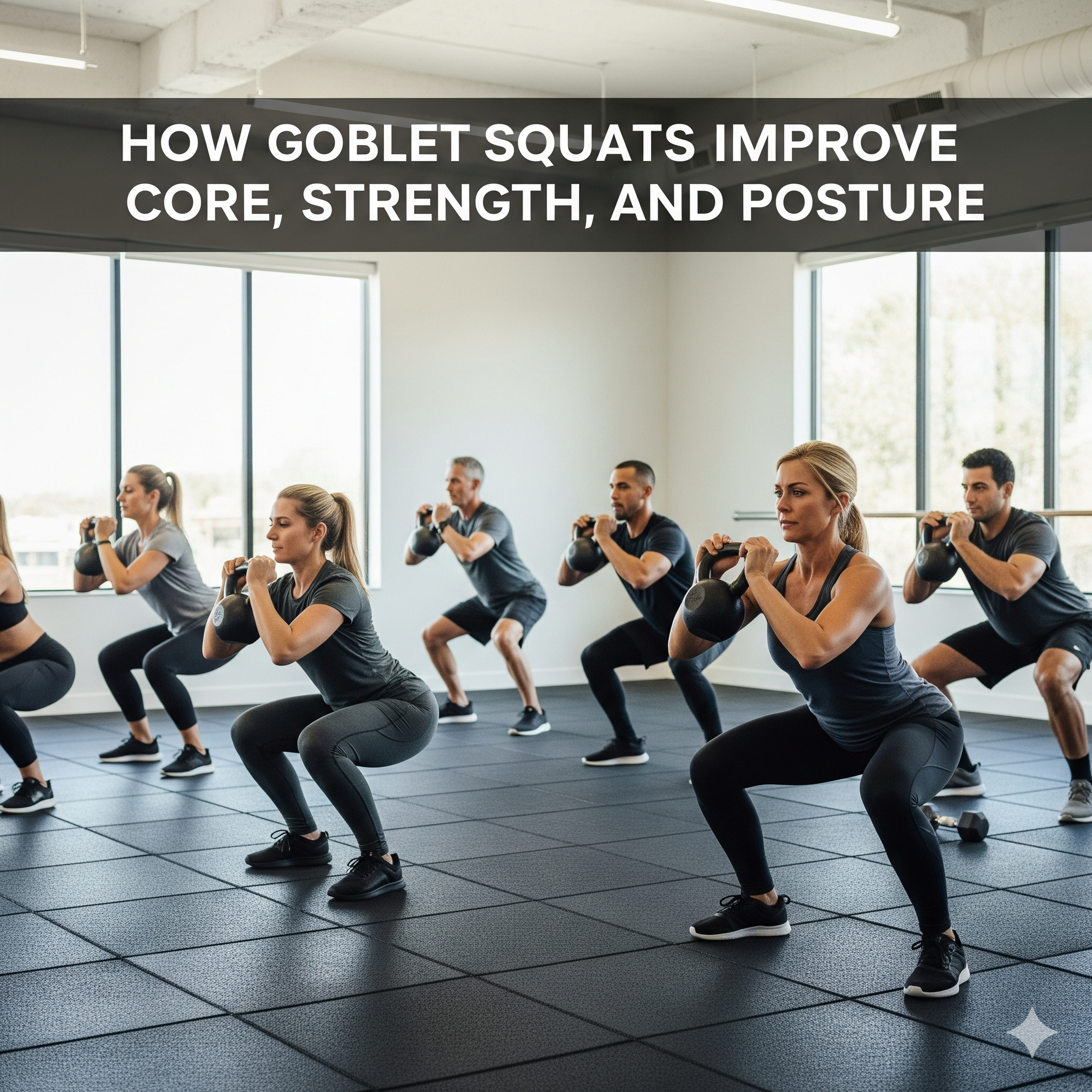
The goblet squat is a squat variation in which you hold a dumbbell or kettlebell vertically in front of your chest, resembling a “goblet.” Unlike back squats, the front-loaded weight encourages a more upright torso, making it easier to maintain proper form. It’s a versatile exercise suitable for beginners learning correct squat mechanics and for advanced lifters seeking a safer alternative to heavy barbell squats.
By keeping the weight in front, you engage your core muscles more than a traditional squat, enhancing stability while targeting the lower body. This makes the goblet squat not only a strength-building exercise but also a functional movement that mirrors everyday activities such as picking up objects from the floor.
Why Goblet Squats Are Effective
-
Improved Squat Mechanics – The front-loaded position encourages an upright chest and neutral spine, helping prevent common form issues like forward lean or lower back rounding.
-
Full Lower Body Activation – Goblet squats work the quadriceps, hamstrings, glutes, and calves. You get a compound movement that develops strength and power.
-
Core Engagement – Holding the weight in front requires your core to stabilize the torso, enhancing abdominal, oblique, and lower-back strength.
-
Joint Mobility and Flexibility – Regular practice improves hip mobility, ankle dorsiflexion, and thoracic spine flexibility, which contributes to deeper, safer squats.
-
Functional Fitness – The movement mimics daily motions like bending, lifting, and standing up, improving overall coordination and movement efficiency.
-
Beginner-Friendly and Scalable – You can start with a light dumbbell or kettlebell, progress in weight, or try advanced variations as your strength and mobility improve.
How to Perform a Goblet Squat
Follow these steps to perform a perfect goblet squat:
1: Grip the Weight
-
Hold a dumbbell vertically against your chest, cupping it with both hands.
-
For a kettlebell, hold it by the horns or handle.
-
Keep elbows tucked in and close to your body.
2: Set Your Feet
-
Stand with feet shoulder-width apart or slightly wider.
-
Toes should point slightly outward.
-
Ensure your weight is evenly distributed on your heels and midfoot, not your toes.
3: Engage Core and Descend
-
Brace your core as if preparing for a punch.
-
Push your hips back and bend your knees simultaneously.
-
Keep chest tall and elbows inside knees.
-
Lower until thighs are at least parallel to the floor or as deep as your mobility allows without rounding your back.
4: Stand Back Up
-
Press through your heels and extend your hips and knees to return to standing.
-
Squeeze glutes at the top to fully engage them.
-
Exhale as you ascend.
Key Benefits of Goblet Squats
1. Strength and Muscle Development
-
Targets quads, hamstrings, glutes, calves, and core simultaneously.
-
Builds strength in the upper back, shoulders, and forearms through weight stabilization.
-
Front-loaded nature emphasizes quadriceps and promotes better squat depth.
2. Core Stability and Balance
-
Holding the weight in front forces your core muscles to engage continuously.
-
Improves overall balance, coordination, and posture.
-
Reduces risk of back injury compared to barbell back squats.
3. Joint Mobility and Flexibility
-
Deep squat position enhances hip, knee, and ankle mobility.
-
Encourages thoracic spine extension for better upright posture.
-
Mobility improvements carry over to other lifts and daily activities.
4. Functional Fitness
-
Simulates real-life movements such as lifting, bending, and carrying objects.
-
Helps strengthen stabilizer muscles and improves neuromuscular control.
-
Contributes to safer movement patterns in daily life.
5. Accessible for All Levels
-
Beginners: Light weight or bodyweight practice to learn form.
-
Intermediate: Moderate weight to increase strength and endurance.
-
Advanced: Heavy or double kettlebell variations for challenge.
6. Cardiovascular and Metabolic Benefits
-
As a compound, full-body movement, goblet squats raise heart rate.
-
Burns calories while strengthening multiple muscle groups simultaneously.
Common Mistakes and How to Correct Them
-
Leaning Forward – Keep chest upright; elevate heels slightly if ankle mobility is limited.
-
Knees Caving In – Push knees outward in the same direction as your toes.
-
Weight Too Far from Body – Hold the dumbbell or kettlebell close to chest to maintain balance.
-
Shallow Squats – Aim for at least parallel or as deep as your mobility allows.
-
Rushing the Movement – Move slowly, especially on the way down (eccentric phase) to build strength.
Mobility Exercises for Better Goblet Squats
Hip Mobility
-
Prying Goblet Squat Hold: Hold a light weight and gently push knees out.
-
90/90 Stretch: Opens hip internal and external rotation.
Ankle Mobility
-
Goblet Squat Ankle Stretch: Shift weight in a deep squat to stretch calves.
-
Wall Ankle Mobilization: Lean into wall with knee tracking forward to improve dorsiflexion.
Thoracic Spine Mobility
-
Quadruped Thoracic Rotations: Rotates upper back to improve chest position.
-
Cat-Cow Stretch: Warms up spine and mobilizes back muscles.
Sample Mobility Routine:
-
Cat-Cow Stretch: 8–10 reps
-
Quadruped Rotations: 8–10 reps per side
-
Down-Dog to Lunge: 5 reps per side
-
Prying Goblet Hold: 30–60 seconds
-
Goblet Ankle Stretch: 3–5 sets per leg
Advanced Goblet Squat Variations
-
Pause Goblet Squat: Hold 2–3 seconds at the bottom to increase time under tension.
-
Tempo Goblet Squat: Slow descent (3–5 seconds) for better muscle control.
-
Single-Leg Goblet Squats: Enhances unilateral strength and stability.
-
Goblet to Overhead Press: Combines squat with upper-body work.
-
Crush Grip Goblet Squat: Squeeze the weight to engage core, arms, and chest more.
-
Double Kettlebell Front Squat: Adds significant load for advanced lifters.
Training Frequency and Programming
1- For Strength & Muscle Growth
-
Frequency: 2–3 days/week
-
Sets/Reps: 3–4 sets of 5–8 reps (heavy), 8–12 reps (moderate)
-
Goal: Build strength and hypertrophy with proper form
2- For Endurance
-
Frequency: 5–7 days/week
-
Sets/Reps: 2–3 sets of 15–20 reps
-
Goal: Develop muscular endurance and maintain mobility
3- For Beginners
-
Focus on perfect form using bodyweight or light weight
-
3–4 sets of 10–12 reps
-
Gradually progress weight and reps as mobility and strength improve
FAQs About Goblet Squats
╠══════════════════════════════════════════════╣
║ Q1: What muscles do goblet squats work? ║
║ A1: Quads, hamstrings, glutes, calves, core,║
║ upper back, and shoulders. ║
╠══════════════════════════════════════════════╣
║ Q2: Are goblet squats safer than barbell ║
║ squats? ║
║ A2: Yes. They place less stress on the lower║
║ back and encourage better upright posture║
╠══════════════════════════════════════════════╣
║ Q3: Can goblet squats help with weight loss? ║
║ A3: Yes. As a compound movement, they engage║
║ multiple muscles and burn calories ║
║ efficiently. ║
╠══════════════════════════════════════════════╣
║ Q4: How can I make goblet squats more ║
║ challenging? ║
║ A4: Increase weight, slow down tempo, pause ║
║ at the bottom, use a resistance band, or║
║ try single-leg variations. ║
╠══════════════════════════════════════════════╣
║ Q5: Can beginners do goblet squats? ║
║ A5: Absolutely. Start with light weight or ║
║ bodyweight to master form, then gradually║
║ increase load. ║
╚══════════════════════════════════════════════╝
Conclusion
The goblet squat is a versatile, safe, and highly effective exercise for building lower-body strength, improving posture, increasing mobility, and enhancing functional fitness. Its front-loaded design engages the core and upper body while targeting quads, glutes, hamstrings, and stabilizer muscles. Suitable for all fitness levels, it can be adapted with variations in tempo, load, and stance to meet different goals—strength, endurance, or mobility. Whether you are a beginner learning proper squat form or an advanced lifter seeking a safer alternative to heavy squats, the goblet squat is a must-have in any strength training program.