
Introduction
Among all bodyweight exercises, few are as powerful and effective as the plank. This simple yet demanding movement engages multiple muscle groups simultaneously, helping you build strength, stability, and endurance without needing any equipment. Unlike dynamic exercises such as push-ups or crunches, planks rely on isometric contraction—holding your body still in a straight line while resisting gravity.
At first glance, it might seem easy to lie on your forearms and toes. But the real challenge comes from maintaining proper form and activating your muscles correctly. Done consistently, planks can improve posture, prevent back pain, boost athletic performance, and even enhance your mental discipline.
This article provides a comprehensive guide to planks: how to perform them, their benefits, variations, beginner-friendly modifications, and why they are superior to crunches for long-term fitness.
How to Perform a Plank Correctly
Performing a plank may look simple, but the key to unlocking its full benefits lies in correct technique. Rather than focusing only on how long you can hold the position, pay attention to alignment, core engagement, and breathing.
Step-by-Step Guide to a Forearm Plank
-
Get into starting position
Lie face-down on a mat. Place your elbows directly beneath your shoulders, with forearms flat on the ground. Keep your hands either flat or clasped together for stability. -
Lift your body
Tighten your abdominal muscles by pulling your navel in toward your spine. Press into your forearms and rise onto your toes, engaging your glutes to steady your hips. -
Form a straight line
Align your body so that it resembles a solid board—from the crown of your head to your heels. Avoid sagging hips or raising your backside too high. -
Keep your neck neutral
Gaze down at the floor, slightly ahead of your hands, to maintain alignment between your head and spine. -
Breathe steadily
Take slow, even breaths throughout the hold. Holding your breath can lead to unnecessary tension and poor posture. -
Hold and release
Maintain the plank for as long as you can without breaking form. Beginners may start with 15–30 seconds and build up gradually. When finished, lower yourself gently back to the floor.
Modifications for Different Fitness Levels
-
Beginner-friendly option: Try a knee plank, keeping your knees on the floor while holding your core tight. This reduces intensity but builds good form.
-
Advanced challenge: Lift one leg or one arm at a time, switch to a high plank on your hands, or practice side planks to target your obliques.
Tips for Perfect Plank Form
Doing a plank may seem simple, but small adjustments in your form make a big difference. To maximize results, aim for a straight line from head to heels, engage your core and glutes, and maintain a neutral neck position.
Setting Up the Plank
-
Hand & Elbow Placement: Place your elbows directly under your shoulders with forearms flat on the floor. Keep hands flat or clasp them together—whichever feels more natural.
-
Foot Positioning: Keep your feet hip-width apart. Beginners can use a wider stance for added balance.
-
Body Alignment: Extend your legs, lift your torso, and balance on forearms and toes. Your body should resemble a rigid plank of wood from head to heels.
Holding the Position
-
Engage Your Core: Pull your belly button in toward your spine to activate your abdominals and prevent your hips from sagging.
-
Squeeze Your Glutes: Keep your hips lifted and stable by tightening your glute muscles.
-
Maintain Neutral Neck Alignment: Look slightly ahead of your hands on the floor to avoid straining your neck.
-
Breathe Consistently: Don’t hold your breath—steady breathing helps maintain posture and endurance.
-
Activate Shoulders: Spread your shoulder blades slightly apart and press into the ground, avoiding shoulder shrugging or collapsing.
Common Mistakes to Watch Out For
-
Sagging Hips: Indicates core fatigue or poor engagement. Correct by squeezing your abs and glutes.
-
Hips Too High: Lifting your butt too far up reduces core activation. Focus on creating a straight line.
-
Neck Strain: Looking up or letting your head drop disrupts alignment—keep your gaze downward.
-
Holding Too Long with Bad Form: Duration doesn’t matter if your posture breaks. Shorter holds with good form are more effective than longer holds with poor alignment.
Benefits of Planking
Physical Benefits
-
Strengthens the Core: Targets abdominals, lower back, and glutes.
-
Improves Posture: Stronger core muscles reduce slouching and back pain.
-
Enhances Flexibility: Stretches shoulders, hamstrings, and arches of the feet.
-
Boosts Balance: Builds stability for better coordination in daily activities.
-
Increases Metabolism: Muscle engagement boosts calorie burn throughout the day.
Mental & Emotional Benefits
-
Stress Reduction: Planks lower cortisol levels while releasing endorphins.
-
Confidence & Discipline: Holding a plank requires determination, reinforcing mental toughness.
-
Improved Mood: Endorphins enhance overall mental well-being.
Common Plank Variations
Basic Variations
-
Forearm Plank: Rest on forearms for stability.
-
High Plank: Support body with hands instead of elbows.
-
Side Plank: Balance on one arm and the side of your foot, targeting obliques.
-
Knee Plank: Beginner-friendly version with knees on the ground.
Moving Planks
-
Plank Jacks: Jump feet apart and together.
-
Walking Plank: Alternate between forearm and high plank.
-
Plank Shoulder Taps: Tap opposite shoulders while balancing.
-
Plank with Leg Lift: Lift one leg to increase intensity.
Advanced Planks
-
Stability Ball Plank: Adds instability for greater core activation.
-
Plank with Arm/Leg Extension: Similar to bird-dog for balance training.
-
Hip Dips: Lower hips side to side for oblique engagement.
-
Plank Push-Ups: Transition between push-up and plank for endurance.
The 30-Day Plank Challenge
A structured plan can help you gradually improve strength and endurance.
-
Week 1: Start with 20–30 seconds, 3–4 sets.
-
Week 2: Increase to 45 seconds–1 minute.
-
Week 3: Aim for 1.5 minutes with variations.
-
Week 4: Hold for 2–3 minutes and incorporate advanced moves.
By the end of 30 days, most individuals notice better posture, stronger abs, and improved balance.
Why Planks Are More Effective Than Crunches
Planks outperform crunches when it comes to building core strength, enhancing stability, and improving overall fitness. Unlike crunches, which mainly target the front abdominal muscles, planks engage the entire core, back, shoulders, and even the lower body. They also place less stress on the spine, making them a safer choice for long-term training, sports performance, and rehabilitation.
More Muscle Recruitment
Full Core Activation:
Crunches primarily isolate the rectus abdominis, the surface-level “six-pack” muscle. In contrast, planks engage the transverse abdominis, obliques, erector spinae, shoulders, and glutes, creating a stronger and more stable core.
Higher Levels of Engagement:
Research indicates that planks stimulate greater muscle activity compared to crunches—even when crunches are repeated in higher volumes.
Functional Strength Advantages
Boosts Athletic Performance:
Planks strengthen the foundation needed for explosive and controlled movements in sports, improving agility, balance, and coordination.
Supports the Spine:
By working the deep stabilizing muscles of the core, planks reinforce spinal alignment and reduce the risk of lower back discomfort during daily tasks and heavy lifting.
Lower Injury Risk
Reduced Spinal Stress:
Crunches involve repeated spinal flexion, which can cause strain or discomfort in the neck and lower back.
Safer Plank Mechanics:
Although proper technique is essential, planks create less compression on the spine, making them a safer core-strengthening option.
Balance and Posture Benefits
Static Core Training:
Because planks are an isometric exercise, they build strength and endurance through sustained tension, which improves coordination and balance.
Improved Postural Control:
Strengthening spinal stabilizers through planks leads to better posture and reduced risk of muscular imbalances.
Beginner-Friendly Plank Modifications
-
Elevated Plank: Use a chair or bench for support.
-
Knee Plank: Keep knees down to reduce intensity.
-
Modified Side Plank: Knees bent at 90 degrees for stability.
-
Side Plank with Kickstand: Extra support with one bent leg.
Progression Tips:
-
Start small—10–20 seconds at a time.
-
Focus on form rather than duration.
-
Rest and repeat multiple sets.
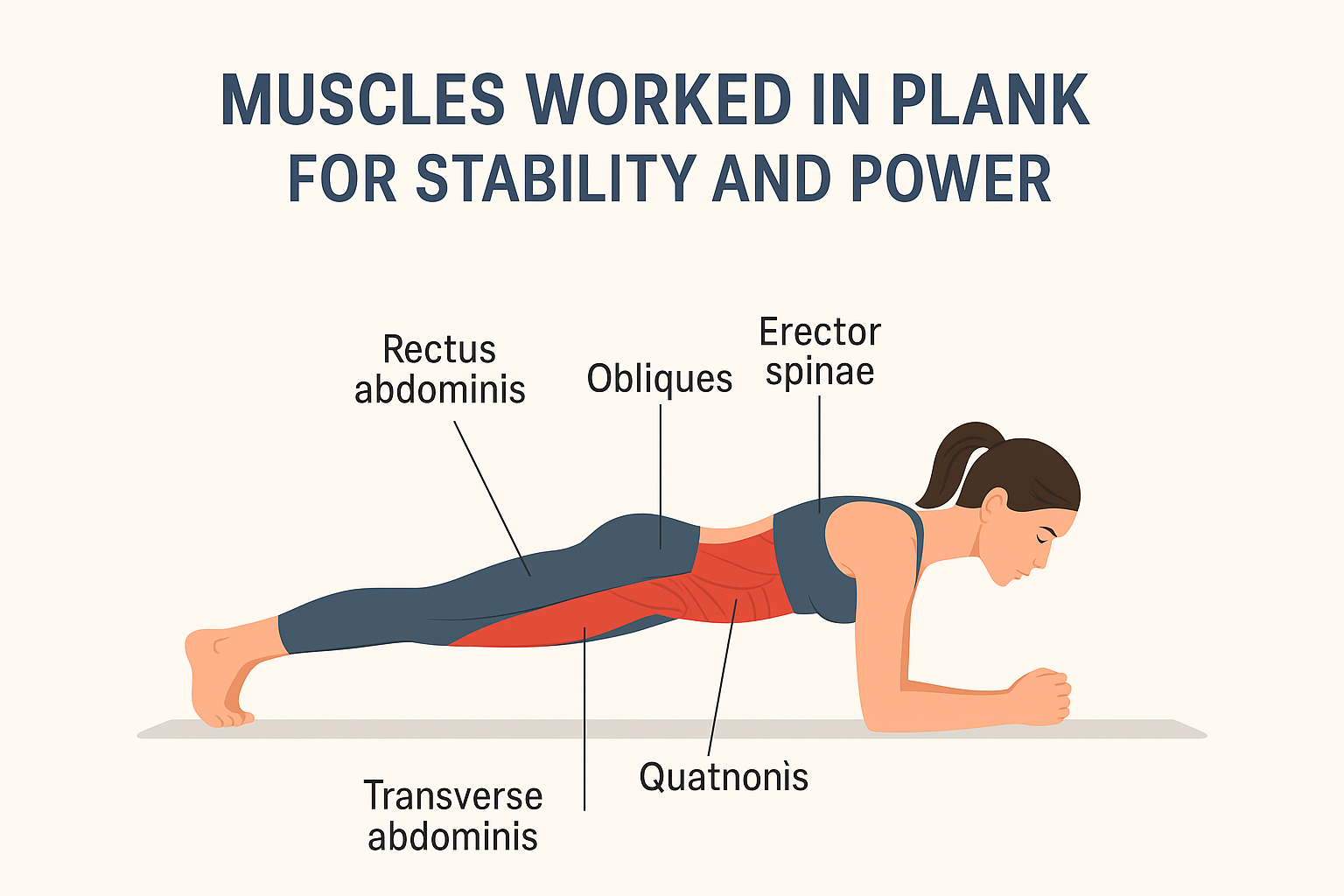
Muscles Worked in a Plank
A plank is more than just a core exercise—it’s a full-body strength move. While it primarily targets the deep abdominal muscles, it also challenges your back, shoulders, glutes, and legs to keep your body stable and aligned.
Core Muscles
-
Transverse Abdominis:
Often called the body’s natural “weight belt,” this deep core muscle wraps around the torso, bracing the spine and pelvis. -
Rectus Abdominis:
Known as the “six-pack” muscle, it plays a key role in maintaining trunk stability during the plank. -
Obliques:
Located along the sides of the midsection, they assist in balance and help control rotation while holding the plank. -
Erector Spinae:
Running parallel to the spine, these muscles keep the lower back supported and prevent sagging.
Upper Body Muscles
-
Deltoids (Shoulders):
These muscles hold your body weight and keep your shoulders stable. -
Trapezius & Rhomboids:
Found in the upper back, they maintain scapular stability and support good posture. -
Pectorals (Chest):
Engage to stabilize the upper body and assist with balance.
Lower Body Muscles
-
Glutes:
The muscles of the buttocks keep the hips lifted and aligned, preventing them from dropping. -
Quadriceps & Hamstrings:
These opposing leg muscles help maintain straight legs and reinforce the plank’s head-to-heel alignment.
Do Planks Help with Weight Loss?
Planks burn few calories directly, but they support weight loss indirectly by:
-
Increasing metabolism.
-
Building lean muscle mass (which burns more calories).
-
Supporting other workouts by improving core stability.
Why Planks Alone Aren’t Enough
-
Low calorie burn: 2–5 calories per minute.
-
No spot reduction: Fat loss happens across the body.
-
Diet matters: A calorie deficit is key for fat loss.
Best Strategy
-
Combine planks with cardio and strength training.
-
Maintain a balanced diet.
-
Progressively challenge yourself with variations.
Common Mistakes to Avoid
-
Sagging Hips: Causes back strain.
-
Hips Too High: Reduces core engagement.
-
Holding Breath: Increases tension and reduces stamina.
-
Looking Up: Strains neck alignment.
-
Rounded Shoulders: Overloads joints.
Correct form is essential to reap the benefits safely.
The Bottom Line
The plank may look simple, but it is one of the most effective exercises for building strength, balance, and posture. Unlike crunches, which target only the abs, planks activate multiple muscle groups for a holistic, functional workout. Whether you’re a beginner starting with knee planks or an advanced athlete adding stability ball challenges, this exercise adapts to your needs.
By practicing consistently and progressing gradually, planks can transform your core strength, athletic performance, and overall confidence. Include them in your fitness routine, pair with cardio and a healthy diet, and watch your strength and endurance soar.